Our publications
They are documents and videos generated by StopAgroparc. The documents are in PDF format
and you can download them both for printing and for reading on screen
The Agroparc does not protect the territory
The political parties in Gelida that support the Agroparc want to convince us that the project is a protection against the industrial pressure of the metropolitan area. But there are two aspects they do not explain to us:
- The Agroparc is not an agricultural project. It represents the establishment of a large industrial and logistics complex, in addition to a large expanse of infrastructure on agricultural land. In total, 70 hectares of infrastructure in a protected area of great natural and agricultural value.
- Ametller is a private company that will transform the project or sell it according to its interests without considering the needs of the community.
That is why we say no. There are tools that are indeed for protecting the territory. Let them use them!
...............
Photo: ©Daniel Garcia Peris
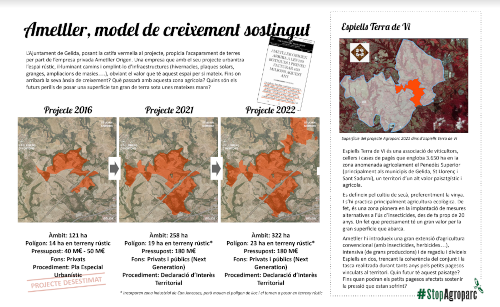
Sustained growth
Politicians and administrations have rolled out the red carpet. Without reservations. Accompanying the company hand in hand, facilitating the adaptation of urban planning and land protection regulations to their liking, creating bespoke quality seals (PAS Seal), accelerating the administrative process according to the company's needs, and so many other things.
But this preferential treatment is not free.
The territory pays for it, the farmers pay for it, we all pay for it.
Not in our name. And in yours?
The Agroparc cannot be developed.
The current planning of Gelida (POUM, 2015) includes the mobility study for the Can Joncoses industrial estate. The technicians determine that the access road is insufficient for the traffic generated by an estate of its characteristics (13 ha) and condition its development on the construction of a new bypass.
Currently, with the recent proposal for an industrial estate (of 23 ha), the mobility study presented by Ametller conceals this obligation. And the politicians give nonsensical excuses to avoid getting involved in its compliance.
Is it the rush?
Is it the money?
Such irresponsibility seems strange when the safety of people is at stake.
More info: This topic was discussed at the Council meeting on 21/03/23, you can see the politicians' responses to the news published on our website..
Impact on the landscape
70 ha of infrastructure cannot be hidden, no matter how well they are designed. Even less so if they are located on a plateau. In a place that, moreover, has the toponym La Talaia (the name says it all).
And all in all, located close to the Serra de l'Ordal. A mountain range known for its castles and viewpoints. The steep gradient means that in just a few metres, the views over the mosaic of Penedès vineyards with Montserrat in the background are spectacular.
But even so, they assure us time and again that it will not be seen. That the impact will be minimal. Disconcerting. Judge for yourselves.
We must not allow them to impose the fait accompli on us. We are still in time to decide what kind of Penedès we want.
Water
L'Ametller estimates the water consumption of the Agroparc at 150,000 m3 annually. This is half the current domestic water consumption of all the inhabitants of Gelida.
In a context of climatic exceptionalism that we have been dragging for some time, and which worsens day by day. Even affecting drinking water. Where will this water come from?
But that is not all.
In the presentation of the 2021 project, they calculated the consumption 💧 at 650,000 m3 (irrigation water). Ametller does not justify the change.
How is this radical reduction in forecasts understood?
Are they telling us the truth?
Are they adjusting values in order to obtain the approval of the administrations?
Nature warns us, but while Gelida is slowly running out of its springs, we continue to stretch the rope. Until when?
Speculation
With the complicity of politicians and administrations, Ametller could end up pocketing a good sum.
In the project that the company presented in 2016, it was already planning a 14 ha industrial estate on rustic land. Back then it did not go well for them. Now they are back, but much better prepared.
Currently, there is indeed an industrial area (not developed), the one at Can Joncoses, precisely 13 hectares. But it seems that now it is no longer enough and they are planning for 23 hectares (curious, isn't it?).
If they succeed, 10 hectares of industrial land will be available at the price of rural land....
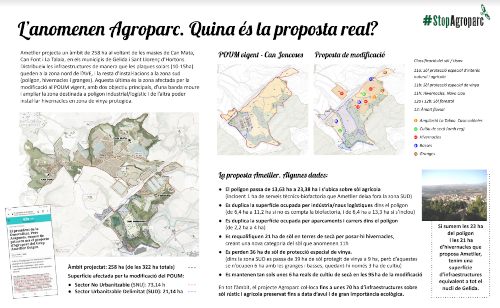
They call it Agroparc.
What is the proposal really?
Analysis of the project 2022
ed. December 2022
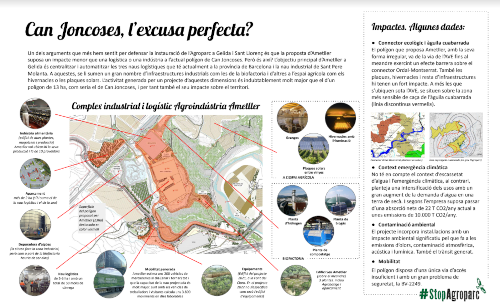
Industrial and logistics complex of
the Ametller agro-industry
Analysis of the project 2022
ed. December 2022
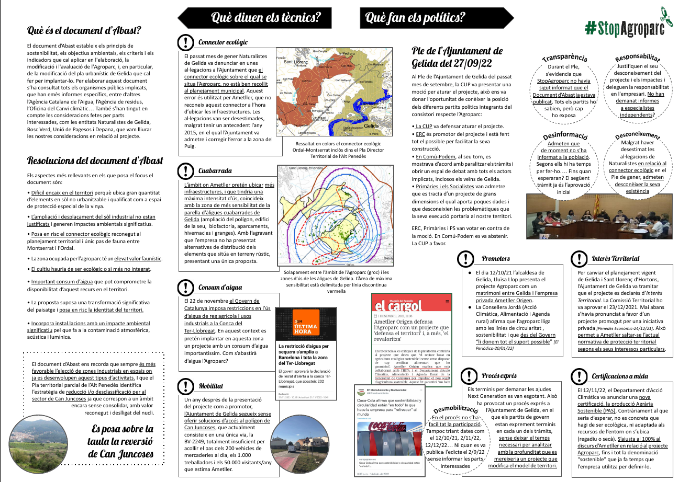
Positioning of technicians and politicians
Response from the Office of Environmental Assessment and from politicians and institutions to the project 2021
ed. November 2022
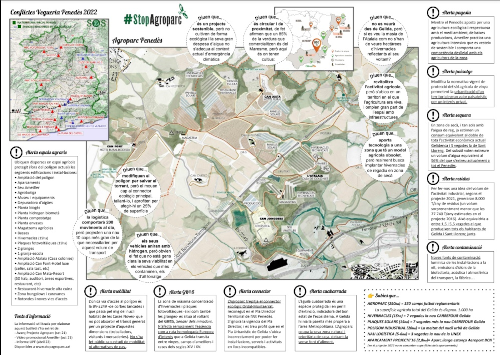
Impacts of the Agroparc project
Analysis of the project 2021
ed. October 2022